Couchbase and MongoDB are the two popular names in the list of NoSQL databases for any developer or business. Each has its own distinct features which make them loved among the developer’s community.
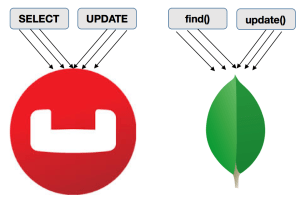
Couchbase Server is an open-source, document-oriented NoSQL database (DB). It is widely chosen for use in developing and deploying web, mobile and IoT applications in the industry. Its customer base includes pioneers in the industry like Cisco, AOL and so on.
MongoDB is again the next generation DB used to develop top-notch applications for large enterprises including web, mobile and IoT. The industry leaders like Adobe, Bosch etc use MongoDB for their applications.
So, if they are as good as the customer base suggests then what essentially differentiates both the DB’s? Here is a consolidated list of some essential features to solve the dilemma. For more info MongoDB Training
Installation & configuration
Couchbase has an integrated admin console and configures everything in a single place. Whereas, Mongo DB follows the master-slave principle and has many moving parts requiring manual configuration.
Structure & format
In Couchbase, the data is written in multiple data files in an append-only manner. These data files are further organized as B-trees. To prevent data from exhausting the disk space, Couchbase periodically cleans up stale data from its storage. On the other hand, Mongo DB stores data into collections of Binary-encoded JavaScript Object Notation or BJSON documents.
Memory
Couchbase uses one of the high-performance caches in the industry, the Memcached protocol and eliminates the need for any external cache. MongoDB requires the use of third-party caches to handle increased users and scalability.
Maintenance
In Couchbase, all the maintenance tasks can be performed using tools like Web UI, Command-line Interface (CLI) or REST API. While for Mongo DB, it can support only CLI tools for maintenance. And sometimes, third-party UI tools can also be used for this purpose.
Supported programming languages
Compared to Couchbase, MongoDB supports more programming languages.
Are you confused regarding your database choice? We can solve this dilemma too. Our qualified professionals have already helped over a thousand of enterprises in their digital transformation journey. Contact us today and get your apps running in the nick of time!
Query Language:
MongoDB uses its own query language that is created with documents in mind. It’s really simple to use:
db.users.find( { first_name : "Alice", birth_year : { $gt : 1986 }}, { username : 1, first_name : 1, last_name : 1 });
- db – denotes the currently selected database. To select a database use command: use name_of_the_db;
- users – name of the collection in the selected database
- find – method on a collection that selects the documents to be returned (it actually returns cursor with the selected documents, but let’s keep it simple)
Two documents are passed as arguments to _find_ method:
{ first_name : “Alice”, birth_year : { $gt : 1986 }} – the first one specifies what kind of documents we are searching for. In this case we are searching for users with first name ‘Alice’, born after 1986. More details on MongoDB Online Course
The second argument is a projection:
{ username : 1, first_name : 1, last_name : 1 } – it basically says return only username, first_name and last_name attributes for the selected documents (and _id which is returned by default).
So, MongoDB uses document structure to specify a query.
Couchbase introduced a N1QL – SQL-like query language, in version 4.0. The same query from above would look like this in N1QL:
Indexes
MongoDB uses a B-Tree data structure for its indexes, which is a quite old and battle-proven way of maintaining database indexes. That is what relational databases use. When combined with correctly modelled data in MongoDB, it provides quite a nice performance.
Unfortunately, the whole point of adding the Index part in this blog post is only because of Couchbase. Something is rotten in the state of Couchbase indexes.
Unlike MongoDB, Couchbase’s indexes are implemented using skip lists. Skip lists are usually used in in-memory databases. And Couchbase, being memory-first, happens to use skip lists for indexes.
It’s a rather young data structure, at least when compared to B-trees (which are 20 years older). So there are probably still some flaws and serious performance trade-offs in different implementations. Learn more from MongoDB Course
Why am I mentioning this at all? Because I lost weeks figuring out how to do some basic queries that will utilize the order of the elements in an index.
For example, it was an epic quest trying to get 50 newest documents, because the query involved ORDER BY timestamp, and it turned out that the ORDER BY clause does not work quite well with indexes in 4.1.1 CE.
Even when a query uses an index for fetching data, it is an order of magnitude slower than MongoDB. But to be clear, Couchbase claims that it is, indeed, slower on a single node environment in comparison with MongoDB, but that it outperforms MongoDB in cluster deployment.
Anyway, asking for help on Couchbase forums for very simple things because of poor documentation/implementation is not quite… well… scalable solution.
Documentation and community:
Having well-documented tools and large community are very important criteria when choosing a technology stack.
MongoDB’s documentation is one of the best I’ve ever seen. It is quite thorough, with lots of examples. They also have high quality free online courses which provide a solid foundation of knowledge and confidence when working with MongoDB.
On December 26th, 2016, there were 74,558 questions on StackOverflow tagged with mongodb.
At the same time there were only 2,155 questions tagged with couchbase. Combined with very poor documentation, choosing Couchbase for building anything with a deadline is a nice way of ruining your mental health.
But take my opinion with a grain of salt. I love simple systems and I prefer having a piece of toast and watching evening news instead of discovering workarounds and how undocumented features work. But if you like a bumpy ride, go for it!
Tooling:
MongoDB has been production ready for a long time (shut up, haters!), and 3rd party tools, as well as built-in ones, are decently built and documented.
Robomongo is an excellent admin UI for Mongo. There are several embedded MongoDB implementations, meaning that they can be started and shut down in integration tests as part of the build process. Get more details about MongoDB Certification
There is no Couchbase version that can be run as part of a build process yet. Also, internal tooling (like export and import tools) is not as powerful as Mongo’s.
For example cbdocloader tool which is used to import JSON into database cannot import JSON array (unlike mongoimport). I am not even sure if you can export data as JSON in 4.1.1.
Couchbase’s cbq tool (in CE version) cannot run query and direct the output to the file. Like mongo shell can (with –eval parameter).
All in all, the tooling in Couchbase gives a sense of unfinished products.
However, the strongest selling point of Couchbase are the following tools:
- Couchbase Lite – mobile version of Couchbase
- Sync Gateway – used for synchronization of Couchbase Lite with Couchbase Server
Together with Couchbase Server, these make a very powerful combo. You get out of the box synchronization across devices and server database. That sounds very promising.
Pricing Model:
MongoDB’s business model is: give the database for free and charge for additional tooling and support. This seems to have become a standard revenue model with companies built around open source tools.
Couchbase works differently. They provide older versions for free, currently 4.1.1 Community Edition (CE), and charge for the newest version, 4.5.1 Enterprise Edition (EE), and support is paid of course.
EE version can also be used in any non-production environment. The problem is that the CE version is currently quite buggy and hardly usable for some cases (like fetching 50 newest documents?!), so it seems like Couchbase wants you to pay for basic features that any other database can provide for free.
And, yes, the documentation sucks, so you better pay for support. Maybe it’s just my millennial entitlement, but I don’t like the idea of paying for support for trivial use cases. I want to have a chance to learn stuff and use the tool for solving business problems on my own.
To get in-depth knowledge, enroll for a live free demo on MongoDB Online Training
 MongoDB Programming