how we use Business Intelligence tools to visualise the mountains of data we accumulate in the course of our Performance Intelligence practice assignments. Even the practice name of “Performance Intelligence” reflects the vital role that such tools and techniques play in deriving insights from all of that data to allow us to get to the bottom of the really hard system performance problems.
Our data visualisation tool of choice is Tableau, because it connects to pretty much any type of data, offers a very wide range of visualisation types and can handle huge volumes of data remarkably quickly when used well.
But up until now we have always treated Tableau as a standalone tool sitting alongside whichever performance testing or metrics collections tools we are using on a performance assignment. For more info Tableau Training
That works fine – but it does mean that the analysis and visualisation doesn’t form an integral part of our workflow in these other tools.
There are lots of opportunities to streamline the workflow, allowing interactive exploration of test results data – drilling down from high-level summaries showing the impact to low-level detail giving strong clues about the cause of issues. If only we could carry context from the performance testing tool to the visualisation tool.
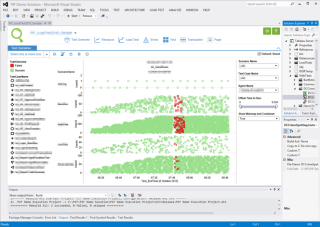
We have recently been working to address that, making use of an integration API which Tableau introduced with their last major release.
First cab off the rank for us was integrating the visualisations into the Microsoft Visual Studio development environment, since that provides one of the performance testing tools which we use extensively in our practice, and the Microsoft Visual Studio environment offers the extensibility points necessary to achieve tight integration.
But whilst the integration is conceptually straightforward – we just want the visualisations to form a seamless part of the experience of using the tool and to know the context (what is the latest test run, for example), actually making it work seamlessly and perform well required careful design and significant software development skills.
The Tableau API uses an asynchronous programming model – JavaScript Promises (so called because when you call an asynchronous method the response you get back is not the answer you are after but a “promise” to return it in due course).
Using this asynchronous model allows the client-side behaviour to remain responsive whilst potentially long-running requests involving millions of rows of data are handled on the Tableau server Training.
Putting a simplistic proof-of-concept together was within my powers, but actually achieving tight integration in a robust and well performing way definitely needed the professionals.
So I’m very glad that we had the services of our Business Application and Product Development business available to do the integration work.
We’re very pleased with the end result, and the folk at Tableau liked it enough to invite me to talk about it at their annual user conference in Seattle – which this year will have a staggering 5,000 attendees.
As part of my conference session I put together a simple demonstration to show how the interactions work. It is a simple standalone web page with an embedded Tableau visualisation object in it – showing how the user can interact with the Tableau visualisation both from controls on the hosting web page and from within the Tableau object itself.
To get in-depth knowledge, enroll for a live free demo on Tableau Online Training
 MongoDB Programming