This Quick Start sets up a flexible, scalable AWS environment for MongoDB, and launches MongoDB into a configuration of your choice.
MongoDB is an open source, NoSQL database that provides support for JSON-styled, document-oriented storage systems. Its flexible data model enables you to store data of any structure, and it provides full index support, sharding, and replication.
Use this Quick Start to set up a customizable MongoDB cluster on AWS. You can customize the number of replica sets (1-3), join the replica sets to a sharded cluster, and configure the instance types and Amazon EBS storage attached to the MongoDB nodes.
The Quick Start is for IT infrastructure architects, administrators, and DevOps professionals who want to administer their own MongoDB environment.
If you want to set up a fully managed database service instead, you can use MongoDB Atlas. for more info MongoDB Certification
MongoDB Atlas creates a new virtual private cloud (VPC) for your managed databases and automates potentially time-consuming administration tasks such as managing, monitoring, and backing up your MongoDB deployments.
Use this Quick Start to automatically set up the following MongoDB environment on AWS:
A virtual private cloud (VPC) configured with public and private subnets across three Availability Zones. This provides the network infrastructure for your MongoDB deployment.*
In the public subnets, NAT gateways to allow outbound internet connectivity for resources (MongoDB instances) in the private subnets.*
In the public subnets, bastion hosts in an Auto Scaling group with Elastic IP addresses to allow inbound Secure Shell (SSH) access.
One bastion host is deployed by default, but this number is configurable.*
An AWS Identity and Access Management (IAM) instance role with fine-grained permissions for access to AWS services necessary for the deployment process.
Security groups to enable communication within the VPC and to restrict access to only necessary protocols and ports.
In the private subnets, a customizable MongoDB cluster with the option of running standalone or in replica sets, along with customizable Amazon EBS storage.
The Quick Start launches each member of the replica set in a different Availability Zone. Learn more skills from MongoDB Training
However, if you choose an AWS Region that doesn’t provide three or more Availability Zones, the Quick Start reuses one of the zones to create the third subnet.
How to deploy:
To build your MongoDB environment on AWS, follow the instructions in the deployment guide. The deployment process includes these steps:
If you don’t already have an AWS account, sign up at https://aws.amazon.com.
Launch the Quick Start. Each deployment takes about 15 minutes. You can choose from two options:
Deploy into a new VPC
Deploy into your existing VPC
Connect to MongoDB nodes on AWS.
To customize your deployment, you can change your network configuration, choose different instance types for your resources, adjust Amazon EBS storage settings (volume type, volume size, and IOPS), and configure MongoDB options such as MongoDB version, number of replica sets, and shard index.
You can get started with MongoDB and your favorite programming language by leveraging one of its drivers, many of which are maintained by MongoDB engineers, and others which are maintained by members of the community. MongoDB has a native Python driver, PyMongo, and a team of Driver engineers dedicated to making the driver fit to the Python community’s needs.
In this article, which is aimed at Python developers who are new to MongoDB, you will do the following:
Install PyMongo, the Python Driver
Connect to MongoDB
Explore MongoDB Collections and Documents
Perform basic Create, Retrieve, Update and Delete (CRUD) operations using PyMongo
Install the Python Driver
For this article we will install the Python driver called, pymongo.
Although there are other drivers written by the community, pymongo is the official Python driver for MongoDB.
The easiest way to install the driver is through the pip package management system. Execute the following on a command line:
python -m pip install pymongo
from pymongo import MongoClient
# pprint library is used to make the output look more pretty
from pprint import pprint
connect to MongoDB, change the << MONGODB URL >> to reflect your own connection string
client = MongoClient(<<MONGODB URL>>)
db=client.admin
# Issue the serverStatus command and print the results
serverStatusResult=db.command("serverStatus")
pprint(serverStatusResult)
Now run this file from the command line with:
python mongodbtest.py
Note that the u character comes from the Python output and it means that the strings are stored in unicode. This example also uses the pprint library which is not related to MongoDB but is used here only to make the output structured and visually appealing from a console. Learn more skills from MongoDB Training
In this example we are connecting to our MongoDB instance and issuing the “db.serverStatus()” command. This command returns information about our MongoDB instance and is used in this example as a way to execute a command against MongoDB.
If your application runs successfully, you are ready to continue.
Exploring Collections and Documents
MongoDB stores data in documents. Documents are not like Microsoft Word or Adode PDF documents but rather JSON documents based on the JSON specification.
Notice that documents are not just key/value pairs but can include arrays and subdocuments. The data itself can be different data types like geospatial, decimal, and ISODate to name a few. Internally MongoDB stores a binary representation of JSON known as BSON. This allows MongoDB to provide data types like decimal that are not defined in the JSON specification
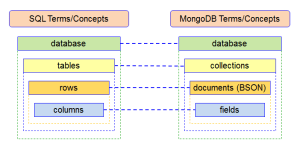
A collection in MongoDB is a container for documents. A database is the container for collections. This grouping is similar to relational databases.
Performing CRUD Operations Using PyMongo
To establish a connection to MongoDB with PyMongo you use the MongoClient class.
from pymongo import MongoClient
client = MongoClient('<<MongoDB URL>>')
The <<MongoDB URL>> is a placeholder for the connection string to MongoDB. See the connection string documentation for detailed information on how to create your MongoDB connection string. If you are using Atlas for your MongoDB database, refer to the “testing your connection” section for more information on obtaining the connection string for MongoDB Atlas. For more info MongoDB Online Training
We can now create a database object referencing a new database, called “business”, as follows:
db = client.business
Once we create this object we can perform our CRUD operations. Since we want something useful to query let’s start by building a sample data generator application.
Generating a Sample Data Code Example
Create a new file called createsamples.py using your development tool or command line text editor and copy the following code:
from pymongo import MongoClient
from random import randint
#Step 1: Connect to MongoDB - Note: Change connection string as needed
client = MongoClient(port=27017)
db=client.business
#Step 2: Create sample data
names = ['Kitchen','Animal','State', 'Tastey', 'Big','City','Fish', 'Pizza','Goat', 'Salty','Sandwich','Lazy', 'Fun']
company_type = ['LLC','Inc','Company','Corporation']
company_cuisine = ['Pizza', 'Bar Food', 'Fast Food', 'Italian', 'Mexican', 'American', 'Sushi Bar', 'Vegetarian']
for x in xrange(1, 501):
    business = {
        'name' : names[randint(0, (len(names)-1))] + ' ' + names[randint(0, (len(names)-1))]  + ' ' + company_type[randint(0, (len(company_type)-1))],
        'rating' : randint(1, 5),
        'cuisine' : company_cuisine[randint(0, (len(company_cuisine)-1))]
    }
    #Step 3: Insert business object directly into MongoDB via isnert_one
    result=db.reviews.insert_one(business)
    #Step 4: Print to the console the ObjectID of the new document
    print('Created {0} of 100 as {1}'.format(x,result.inserted_id))
#Step 5: Tell us that you are done
print('finished creating 100 business reviews')
Be sure to change the MongoDB client connection URL to one that points to your MongoDB database instance. Once you run this application, 500 randomly named businesses with their corresponding ratings will be created in the MongoDB database called, “business”. All of these businesses are created in a single collection called, “reviews”. Notice that we do not have to explicitly create a database beforehand in order to use it. This is different from other databases that requires statements like, “CREATE DATABASE” to be performed first.
The command that inserts data into MongoDB in this example is the insert_one() function, which will insert one document into MongoDB. The result set will return the single ObjectID that was created. This is one of a few methods that insert data. If you wanted to insert multiple documents in one call you can use the insert_many function. In addition to an acknowledgement of the insertion, the result set for insert_many will include a list of the ObjectIDs that were created.
We are now ready to explore querying and managing data in MongoDB using Python. To guide this exploration we will create another application that will manage our business reviews.
In this tutorial, you’ll learn how to integrate MongoDB with your Python applications.
MongoDB is a leading open-source N0SQL database that is written in C++. This tutorial will give the reader a better understanding of MongoDB concepts needed in integrating MongoDB in your Python applications.
The SQL vs. NoSQL Difference
SQL databases use Structured Query Language(SQL) in defining and manipulating data. When using SQL, we need a Relational Database Management System(RDBMS) server such as SQL Server, MySQL server or MS Access. Data in RDBMS is stored in database objects called tables. A table is a collection of related data entries, and it consists of columns and rows.
A NoSQL database has a dynamic schema for unstructured data. In NoSQL, data is stored in several ways: it can be column-oriented, document-oriented, graph-based or organized as a key-value store. A NoSQL database has the following advantages:
Documents can be created without having to first define their structure
Each document can have its own unique structure
The syntax can vary from database to database
Large volumes of structured, semi-structured, and unstructured data
Object-oriented programming that is easy to use and flexible
It is horizontally scalable
NoSQL Database Types
The following are the different types of NoSQL databases:
Document databases pair each key with a complex data structure known as a document. A document is a set of key-value pairs. MongoDB is an example of a document store database. A group of MongoDB documents is known as a collection. This is the equivalent of an RDBMS table.
Graph stores are used to store information about networks of data, for instance, social connections. Graph stores include Neo4J and Giraph.
Key-value stores databases store every single item in the database as a key together with its value. Examples of key-value stores are Riak and Berkeley DB. Some key-value stores, such as Redis, allow each value to have a type, such as an integer, which adds functionality.
Wide-column stores such as Cassandra and HBase are optimized for queries over large datasets, and store columns of data together, instead of rows.
MongoDB and Python
In order to start using MongoDB, we first have to install it. Installation instructions are found at the official MongoDB documentation. To run a quick install on Ubuntu run the commands below: Learn more from MongoDB Training
sudo apt update sudo apt install -y mongodb
Once this is done we’ll check the service and database by running this command on the terminal:
Now that we have MongoDB installed we need a way to interact with it in our Python code. The official Python MongoDB driver is called PyMongo. We can install it using pip as shown below:
pip install pymongo
Its possible for us to interact with MongoDB from the terminal, however for the purposes of this tutorial we’ll run all our code in a Jupyter Notebook.
Making a Connection with MongoClient
The first thing we need to do is import pymongo. The import should run without any errors to signify that we’ve done our installation well.
import pymongo
Establishing a connection in MongoDB requires us to create a MongoClient to the running MongoDB instance.
from pymongo import MongoClient
client = MongoClient()
The above code will connect to the default host and port, but we can specify the host and port as shown below:
To create a database in MongoDB, we use the MongoClient instance and specify a database name. MongoDB will create a database if it doesn’t exist and connect to it.
db = client['datacampdb']
It is important to note that databases and collections are created lazily in MongoDB. This means that the collections and databases are created when the first document is inserted into them. Learn more skills from MongoDB Certification
Data in MongoDB
Data in MongoDB is represented and stored using JSON-Style documents. In PyMongo we use dictionaries to represent documents. Let’s show an example of a PyMongo document below:
 article = {"author": "Derrick Mwiti",
            "about": "Introduction to MongoDB and Python",
            "tags":
                ["mongodb", "python", "pymongo"]}
Inserting a Document
To insert a document into a collection, we use the insert_one() method. As we saw earlier, a collection is similar to a table in RDBMS while a document is similar to a row.
articles = db.articles
result = articles.insert_one(article
When the document is inserted, a special key _id is generated and its unique to this document. We can print the document ID as shown below:
print("First article key is: {}".format(result.inserted_id))
First article key is: 5ba5c05e2e8ca029163417f8
The articles collection is created after inserting the first document. We can confirm this using the list_collection_names method.
db.list_collection_names()
['articles', 'user']
We can insert multiple documents to a collection using the insert_many() method as shown below.
article1 = {"author": "Emmanuel Kens",
            "about": "Knn and Python",
            "tags":
                ["Knn","pymongo"]}
article2 = {"author": "Daniel Kimeli",
            "about": "Web Development and Python",
            "tags":
                ["web", "design", "HTML"]}
new_articles = articles.insert_many([article1, article2])
print("The new article IDs are {}".format(new_articles.inserted_ids))
The new article IDs are [ObjectId('5ba5c0c52e8ca029163417fa'), ObjectId('5ba5c0c52e8ca029163417fb')]
Retrieving a Single Document with find_one()
find_one() returns a single document matching the query or none if it doesn’t exist. This method returns the first match that it comes across. When we call the method below, we get the first article we inserted into our collection.
print(articles.find_one())
{'_id': ObjectId('5ba5c0b52e8ca029163417f9'), 'author': 'Derrick Mwiti', 'about': 'Introduction to Mo
If using Windows, MongoDB is installed at C:\Program Files\MongoDB by default. Add C:\Program Files\MongoDB\Server\<version_number>\bin to the Path environment variable. This change enables MongoDB access from anywhere on your development machine.
Use the mongo Shell in the following steps to create a database, make collections, and store documents.
Choose a directory on your development machine for storing the data. For example, C:\BooksData on Windows. Create the directory if it doesn’t exist. The mongo Shell doesn’t create new directories.
Open a command shell. Run the following command to connect to MongoDB on default port 27017. Remember to replace <data_directory_path> with the directory you chose in the previous step.
console
mongod --dbpath <data_directory_path>
Open another command shell instance. Connect to the default test database by running the following command:
console
mongo
Run the following in a command shell:
console
use BookstoreDb
If it doesn’t already exist, a database named BookstoreDb is created. If the database does exist, its connection is opened for transactions. For more info MongoDB Training
Create a Books collection using following command:
console
db.createCollection('Books')
The following result is displayed:
console
{ "ok" : 1 }
Define a schema for the Books collection and insert two documents using the following command:
console
db.Books.insertMany([{'Name':'Design Patterns','Price':54.93,'Category':'Computers','Author':'Ralph Johnson'}, {'Name':'Clean Code','Price':43.15,'Category':'Computers','Author':'Robert C. Martin'}])
View the documents in the database using the following command:
console
db.Books.find({}).pretty()
The following result is displayed:
console
{
  "_id" : ObjectId("5bfd996f7b8e48dc15ff215d"),
  "Name" : "Design Patterns",
  "Price" : 54.93,
  "Category" : "Computers",
  "Author" : "Ralph Johnson"
}
{
  "_id" : ObjectId("5bfd996f7b8e48dc15ff215e"),
  "Name" : "Clean Code",
  "Price" : 43.15,
  "Category" : "Computers",
  "Author" : "Robert C. Martin"
}
The schema adds an autogenerated _id property of type ObjectId for each document.
The database is ready. You can start creating the ASP.NET Core web API.
Create the ASP.NET Core web API project
Go to File > New > Project.
Select the ASP.NET Core Web Application project type, and select Next.
Name the project BooksApi, and select Create.
Select the .NET Core target framework and ASP.NET Core 3.0. Select the API project template, and select Create.
Visit the NuGet Gallery: MongoDB.Driver to determine the latest stable version of the .NET driver for MongoDB. In the Package Manager Console window, navigate to the project root. Run the following command to install the .NET driver for MongoDB:
Add an entity model
Add a Models directory to the project root.
Add a Book class to the Models directory with the following code:
using MongoDB.Bson;
using MongoDB.Bson.Serialization.Attributes;

namespace BooksApi.Models
{
    public class Book
    {
        [BsonId]
        [BsonRepresentation(BsonType.ObjectId)]
        public string Id { get; set; }

        [BsonElement("Name")]
        public string BookName { get; set; }

        public decimal Price { get; set; }

        public string Category { get; set; }

        public string Author { get; set; }
    }
}
In the preceding class, the Id property:
Is required for mapping the Common Language Runtime (CLR) object to the MongoDB collection.
Is annotated with [BsonId] to designate this property as the document’s primary key.
Is annotated with [BsonRepresentation(BsonType.ObjectId)] to allow passing the parameter as type string instead of an ObjectId structure. Mongo handles the conversion from string to ObjectId. Leran more skills with MongoDB Certification
The BookName property is annotated with the [BsonElement] attribute. The attribute’s value of Name represents the property name in the MongoDB collection.
Add a configuration model:
Add the following database configuration values to appsettings.json:
Add a BookstoreDatabaseSettings.cs file to the Models directory with the following code:
namespace BooksApi.Models
{
    public class BookstoreDatabaseSettings : IBookstoreDatabaseSettings
    {
        public string BooksCollectionName { get; set; }
        public string ConnectionString { get; set; }
        public string DatabaseName { get; set; }
    }

    public interface IBookstoreDatabaseSettings
    {
        string BooksCollectionName { get; set; }
        string ConnectionString { get; set; }
        string DatabaseName { get; set; }
    }
}
The preceding BookstoreDatabaseSettings class is used to store the appsettings.json file’s BookstoreDatabaseSettings property values. The JSON and C# property names are named identically to ease the mapping process.
Add the following highlighted code to Startup.ConfigureServices:
public void ConfigureServices(IServiceCollection services)
{
    // requires using Microsoft.Extensions.Options
    services.Configure<BookstoreDatabaseSettings>(
        Configuration.GetSection(nameof(BookstoreDatabaseSettings)));

    services.AddSingleton<IBookstoreDatabaseSettings>(sp =>
        sp.GetRequiredService<IOptions<BookstoreDatabaseSettings>>().Value);

    services.AddControllers();
}
In the preceding code:
The configuration instance to which the appsettings.json file’s BookstoreDatabaseSettings section binds is registered in the Dependency Injection (DI) container.
For example, a BookstoreDatabaseSettings object’s ConnectionString property is populated with the BookstoreDatabaseSettings:ConnectionString property in appsettings.json.
The IBookstoreDatabaseSettings interface is registered in DI with a singleton service lifetime. When injected, the interface instance resolves to a BookstoreDatabaseSettings object.
Add the following code to the top of Startup.cs to resolve the BookstoreDatabaseSettings and IBookstoreDatabaseSettings references:
C#
using BooksApi.Models;
Add a CRUD operations service
Add a Services directory to the project root.
Add a BookService class to the Services directory with the following code:
using BooksApi.Models;
using MongoDB.Driver;
using System.Collections.Generic;
using System.Linq;

namespace BooksApi.Services
{
    public class BookService
    {
        private readonly IMongoCollection<Book> _books;

        public BookService(IBookstoreDatabaseSettings settings)
        {
            var client = new MongoClient(settings.ConnectionString);
            var database = client.GetDatabase(settings.DatabaseName);

            _books = database.GetCollection<Book>(settings.BooksCollectionName);
        }

        public List<Book> Get() =>
            _books.Find(book => true).ToList();

        public Book Get(string id) =>
            _books.Find<Book>(book => book.Id == id).FirstOrDefault();

        public Book Create(Book book)
        {
            _books.InsertOne(book);
            return book;
        }

        public void Update(string id, Book bookIn) =>
            _books.ReplaceOne(book => book.Id == id, bookIn);

        public void Remove(Book bookIn) =>
            _books.DeleteOne(book => book.Id == bookIn.Id);

        public void Remove(string id) =>
            _books.DeleteOne(book => book.Id == id);
    }
}
In the preceding code, an IBookstoreDatabaseSettings instance is retrieved from DI via constructor injection. This technique provides access to the appsettings.json configuration values that were added in the Add a configuration model section.
Add the following highlighted code to Startup.ConfigureServices:
In the preceding code, the BookService class is registered with DI to support constructor injection in consuming classes. The singleton service lifetime is most appropriate because BookService takes a direct dependency on MongoClient.
Add the following code to the top of Startup.cs to resolve the BookService reference:
using BooksApi.Services;
The BookService class uses the following MongoDB.Driver members to perform CRUD operations against the database:
MongoClient – Reads the server instance for performing database operations. The constructor of this class is provided the MongoDB connection string:
public BookService(IBookstoreDatabaseSettings settings)
{
    var client = new MongoClient(settings.ConnectionString);
    var database = client.GetDatabase(settings.DatabaseName);

    _books = database.GetCollection<Book>(settings.BooksCollectionName);
}
IMongoDatabase – Represents the Mongo database for performing operations. This tutorial uses the generic GetCollection<TDocument>(collection) method on the interface to gain access to data in a specific collection.
Perform CRUD operations against the collection after this method is called. In the GetCollection<TDocument>(collection) method call:
collection represents the collection name.
TDocument represents the CLR object type stored in the collection.
GetCollection<TDocument>(collection) returns a MongoCollection object representing the collection. In this tutorial, the following methods are invoked on the collection:
DeleteOne – Deletes a single document matching the provided search criteria.
Find<TDocument> – Returns all documents in the collection matching the provided search criteria.
InsertOne – Inserts the provided object as a new document in the collection.
ReplaceOne – Replaces the single document matching the provided search criteria with the provided object.
Add a controller
Add a BooksController class to the Controllers directory with the following code:
using BooksApi.Models;
using BooksApi.Services;
using Microsoft.AspNetCore.Mvc;
using System.Collections.Generic;

namespace BooksApi.Controllers
{
    [Route("api/[controller]")]
    [ApiController]
    public class BooksController : ControllerBase
    {
        private readonly BookService _bookService;

        public BooksController(BookService bookService)
        {
            _bookService = bookService;
        }

        [HttpGet]
        public ActionResult<List<Book>> Get() =>
            _bookService.Get();

        [HttpGet("{id:length(24)}", Name = "GetBook")]
        public ActionResult<Book> Get(string id)
        {
            var book = _bookService.Get(id);

            if (book == null)
            {
                return NotFound();
            }

            return book;
        }

        [HttpPost]
        public ActionResult<Book> Create(Book book)
        {
            _bookService.Create(book);

            return CreatedAtRoute("GetBook", new { id = book.Id.ToString() }, book);
        }

        [HttpPut("{id:length(24)}")]
        public IActionResult Update(string id, Book bookIn)
        {
            var book = _bookService.Get(id);

            if (book == null)
            {
                return NotFound();
            }

            _bookService.Update(id, bookIn);

            return NoContent();
        }

        [HttpDelete("{id:length(24)}")]
        public IActionResult Delete(string id)
        {
            var book = _bookService.Get(id);

            if (book == null)
            {
                return NotFound();
            }

            _bookService.Remove(book.Id);

            return NoContent();
        }
    }
}
The NoSQL database, MongoDB, avoids the traditional RDBMS table structure in favour of JSON-like documents with dynamic schemas. This makes the integration of data in certain types of applications easier and faster. MongoDB is most favoured for document stores
MongoDB is a document-oriented database from the NoSQL family. Document databases are suitable for storing and managing Big Data-sized collections of literal documents like text documents, email messages, XML documents, etc.
Documents are de-normalised (aggregate) representations of a database entity, and are suitable for storing semi-structured data that would require the extensive use of nulls in an RDBMS.
An aggregated document can be accessed with a single call to the database rather than having to join multiple tables to respond to a query. The schema in such databases are dynamic, unlike the relational databases, which require the schemas to be defined in advance.
So for agile development approaches, traditional relational models are sometimes not suitable, because each time a new feature is added, the complete schema has to be modified. For more info MongoDB Training
In MongoDB, a record is a document that gets stored in a binary (JSON) format and documents are grouped together into collections. Collections are similar to the tables from relational databases.
The key features of MongoDB are:
high performance by supporting embedded data models and indexes
high availability by replica sets to provide automatic failover and data redundancy,
automatic scaling by automatic sharding
flexible schema (as the schema of one document can be different from the other within the same collection).
There are several reserved databases, such as the following.
admin: This is a root database. There are certain serverwide commands like readAnyDatabase, readWriteAnyDatabase, dbAdminAnyDatabase, userAdminAnyDatabase, clusterAdmin, etc, that can be run only from the admin database. If users are added to the admin database, they automatically inherit permissions for all the databases.
local: In replication, the local database stores internal replication data for each member of a replica set. Collections from this database will not be replicated.
config: This database will store information about shards (which is explained later in this article).
Core components of the MongoDB package Mongod: This is a core database process which handles data requests, manages data formats and performs background management operations. Mongos: This is the controller and query router for sharded clusters, and does the routing service for MongoDB shard configurations, processes and queries from the application layer to determine the location of data in the sharded cluster.
Mongo: This interactive MongoDB shell provides a powerful interface for systems administrators as well as a way for developers to test queries and operations directly with the database. Learn more skills from MongoDB Certification
Installation of MongoDB MongoDB can be installed on most platforms (Linux, OS X, Windows ), and supports both 32-bit and 64-bit architectures. You can go through the following steps to install MongoDB on your machine, if you are using Ubuntu (version 14+).
Import the public key: The Ubuntu package management tools (i.e., dpkg and apt) ensure package consistency and authenticity by requiring that distributors sign packages with GPG keys. Issue the following command to import the MongoDB public GPG key:
Here is an increasing demand for NoSQL database experts, especially those highly trained on Hadoop & MongoDB. This is mainly due to the fact that NoSQL databases are replacing traditional RDBMs as NoSQL databases like It offers the flexibility to organize data in a way that makes the data usable.
This along with the proverbial explosion of data from various digital medias has forced organizations to look for alternatives to match the colossal speed of Big Data.
NoSQL databases are adept at handling Big Data using document structures for storing data in loosely defined objects, making it a best choice for handling Big Data challenges. As a result, MongoDB has now become one of the leading NoSQL database solution.
Let us look at the various reasons that make MongoDB a lucrative option for your career.
Huge Demand for MongoDB Skills:
MongoDB is fast becoming an industry trend and is gaining popularity for its powerful query language and its easy transition from a relational database to NoSQL database. With increasing implementation of Big Data and its technologies, it is a natural progression for the organizations to look for MongoDB skills.
According to a report by Allied Market Research, the growing awareness of the benefits of NoSQL over RDBMS has resulted in increased demand for MongoDB skills, especially in sectors like, social networks, retail and e-commerce.
The global NoSQL market is predicted to reach $4.2 billion by the end of 2020, growing at 35.1% CAGR between 2014 and 2020.
The adoption of NoSQL over SQL database is largely driven by trends such as integration among different NoSQL technologies and between SQL and NoSQL database and the increasing demand for Cloud Computing technology, which are dominating the IT market. More info at MongoDB Online Training
What are the other capacities that MongoDB intends to include in its architecture?
Predictions say that they will focus on the analytical performance by adopting a Spark connector that could handle bulky analytics. There is also possibility of columnar data-store while the option for streaming data through engine is always available.
The ancestor to MongoDB’s business is still the open-core model. However, it has become a much complicated and intricate collection of value-added add-ons that can only be accessed through subscription. These features include management console, extra in-memory and encrypted storage engines, BI connectivity, DBA tools and authentication with access-control options.
Currently, the targeted evolutionary step is of bringing in the cloud database business. While companies could always mount MongoDB on cloud infrastructures like Google Cloud Platform, AWS or Azure, it had to be managed on one’s own.
One could also pick up a third-party MongoDB DBaaS (DataBase-as-a-Service). Now, MongoDB is starting to launch its own DBaas called Atlas that would face competitive prices. Its features include wider replication, availability of updated versions and disaster recovering solutions.
The expansion of database is not a MongoDB-confined move. The entire database market is witnessing a move towards addition of extensions onto platforms. For instance, giants like DB2, Teradata, Oracle and SQL Server are introducing in-memory, columnar, geospatial and graph capacities. For more info MongoDB Training
Such powers are introduced through extension of query language or by graft of new storage engines. In response to the quietly increasing list of features taken up by the opponents (like Hadoop and NoSQL army), MongoDB can be prophesized to launch data-protection options (like access control at level of field).
MongoDB is well known for its ability to interpret and manipulate complex data. Currently, it is focused on new workloads (like live/operational workloads).
MongoDB is thus gradually undergoing evolution but it should remember the breeding ground of its birth: the developer-oriented platform for managing apps that need the capacity to handle the complex document-style data.
Works Well With Hadoop:
As Big Data is becoming bigger, enterprise are increasingly relying on Hadoop and prominent NoSQL databases. A recent survey conducted by Dice estimates that salaries for employees who use Hadoop and NoSQL are more than $100,000.
Meaning that the combination of these skills are the most sought after by leading organizations in the field of Big Data. More than One third of the Fortune 100 companies are harnessing the power of Hadoop & MongoDB together to create complete Big Data applications:
Many organizations are harnessing the power of Hadoop & MongoDB together to create complete Big Data applications:
MongoDB powers the online, real-time operational application, serving business processes and end-users
Hadoop consumes data from MongoDB, blending it with data from other sources for sophisticated analytics and Machine Learning. The result is then loaded back to MongoDB to serve smarter operational processes.
MongoDB is a Go-to Choice for Many Organizations:
Among the Fortune 500 and Global 500 companies, MongoDB is already serving 10 of the top financial services institutions, electronics companies, media and entertainment companies, retailers, etc.
Here is the list of other sectors looking for MongoDB skills:
Now, let’s start implementing Mongo queries with Java. We will follow with the basic CRUD operations as they are the best to start with.
Make a Connection with MongoClient
First, let’s make a connection to a MongoDB server. With version >= 2.10.0, we’ll use the MongoClient:
MongoClient mongoClient = new MongoClient("localhost", 210189);
And for older versions use Mongo class:
Mongo mongo = new Mongo("localhost", 27017);
Connecting to a Database
Now, let’s connect to our database. It is interesting to note that we don’t need to create one. When Mongo sees that database doesn’t exist, it will create it for us:
DB database = mongoClient.getDB("myMongoDb");
Sometimes, by default, MongoDB runs in authenticated mode. In that case, we need to authenticate while connecting to a database. For programming skills MongoDB Course
We can do it as presented below:
MongoClient mongoClient = new MongoClient();
DB database = mongoClient.getDB("myMongoDb");
boolean auth = database.authenticate("username", "pwd".toCharArray());
Show Existing Databases
Let’s display all existing databases. When we want to use the command line, the syntax to show databases is similar to MySQL: Get MongoDB Certification for a bright future.
show databases;
In Java, we display databases using snippet below:
Let’s start by creating a Collection (table equivalent for MongoDB) for our database. Once we have connected to our database, we can make a Collection as:
database.createCollection("customers", null);
Now, let’s display all existing collections for current database:
It is a well known fact that SQL databases have ruled the world of data technologies and have been the primary source of data storage for over 4 decades. Generally the SQL databases are used, mainly for accessing relational databases.
Oracle and Microsoft SQL Server ruled the segment, but as the Web development market paced up, there came a shift towards usage of open source databases like MySQL, Postgres etc. But RDBMS was still the first choice.
Soon enough data started growing exponentially and scalability became a major issue, at that time NoSQL rolled in to save the day. For more info MongoDB Online Training
One of the cool facts about NoSQL databases is that they existed since 1960, but in the recent times they have gained more popularity especially for the scaling feature provided by the same.
The major difference between MongoDB and SQL Databases is the way they handle data. In SQL databases, data is stored in form of traditional 2 dimensional row-column structure while in MongoDB rich data document model is followed, which allows storage of any type of data.
Let us see some of the key differences between MongoDB and other SQL databases :
SQL Database
NoSQL Database (MongoDB)
Relational database
Non-relational database
Supports SQL query language
Supports JSON query language
Table based
Collection based and key-value pair
Row based
Document based
Column based
Field based
Support foreign key
No support for foreign key
Support for triggers
No Support for triggers
Contains schema which is predefined
Contains dynamic schema
Not fit for hierarchical data storage
Best fit for hierarchical data storage
Vertically scalable – increasing RAM
Horizontally scalable – add more servers
Emphasizes on ACID properties (Atomicity, Consistency, Isolation and Durability)
Emphasizes on CAP theorem (Consistency, Availability and Partition tolerance)
MongoDB Documents also align with the structure of objects in modern programming languages, as they are a form of JSON.
This makes it easy for developers to map the data used in the application to its associated document in the database.
While in SQL Database, creating a table with columns mapped to the attributes of an object in programming language, appears a little tedious.
We know that the data in MongoDB is stored in form of documents. These documents are stored in Collection and Collection is stored in Database.
Two ways to Create a Collection
Here are two ways of creating collections:
You can create a collection on the fly when inserting a document (using the insert() method.
You can also create a collection explicitly, using the createCollection() method.
Definition
db.createCollection(name, options)
Creates a new collection or view.
Because MongoDB creates a collection implicitly when the collection is first referenced in a command, this method is used primarily for creating new collections that use specific options. For example, you use db.createCollection() to create a capped collection, or to create a new collection that uses document validation.
db.createCollection() is a wrapper around the database command create.
The db.createCollection() method has the following prototype form: Lets see the options that we can provide while creating a collection: capped: type: boolean.
This parameter takes only true and false. This specifies a cap on the max entries a collection can have. Once the collection reaches that limit, it starts overwriting old entries. The point to note here is that when you set the capped option to true you also have to specify the size parameter. Learn more skills from MongoDB Certification
size: type: number. This specifies the max size of collection (capped collection) in bytes.
max: type: number. This specifies the max number of documents a collection can hold.
autoIndexId: type: boolean The default value of this parameter is false. If you set it true then it automatically creates index field _id for each document.
The created user can execute db.createCollection() on the specified databases.
Alternatively, you can add the required roles to an existing user using db.grantRolesToUser()
Create a Collection with Document Validation
Collections with validation compare each inserted or updated document against the criteria specified in the validator option. Depending on the validationLevel and validationAction, MongoDB either returns a warning, or refuses to insert or update the document if it fails to meet the specified criteria.
db.createCollection( "contacts", {
   validator: { $jsonSchema: {
      bsonType: "object",
      required: [ "phone" ],
      properties: {
         phone: {
            bsonType: "string",
            description: "must be a string and is required"
         },
         email: {
            bsonType : "string",
            pattern : "@mongodb\.com$",
            description: "must be a string and match the regular expression pattern"
         },
         status: {
            enum: [ "Unknown", "Incomplete" ],
            description: "can only be one of the enum values"
         }
      }
   } }
} )
In MongoDB, the first basic step is to have a database and collection in place. The database is used to store all of the collections, and the collection in turn is used to store all of the documents.
The documents in turn will contain the relevant Field Name and Field values. For more info MongoDB Online Training
MongoDB didn’t provides any command to create “database“. Actually, you don’t need to create it manually, because, MangoDB will create it on the fly, during the first time you save the value into the defined collection (or table in SQL), and database.
For developer from SQL background, we need to create a database, table and insert values into table manually. In MongoDB, you don’t need to mention what you want to create, when first time you save the value into the defined collection (table), under selected database, MangoDB will create the value, collection and database automatically.
Define a database name:
Issue “use new-databasename” to switch from default database to define database (even non-exists database name will work). However, MangoDB doesn’t create any database yet, until you save something inside.
> use abcd
switched to db abcddb
> show dbs
admin   0.04125GB
local   (empty)
MongoShell: The mongo shell is an interactive JavaScript interface to query and update data as well as perform administrative operations in MongoDB.
Databases: In MongoDB, databases basically holds the collections of documents. A database contains collection which contains the document. On a single MongoDB server, we can run multiple databases. Default created database of MongoDB is ‘db’ present within the data folder. When you install MongoDB some databases are automatically generated to use.so we can say that it is not required to create a database before you start working with it. Learn more programming skills from MongoDB Training
Create a New Database : You can create a new Database in MongoDB by using “use Database_Name” command. The command creates a new database if it doesn’t exist, otherwise, it will return the existing database.you can run this command in mongo shell to create a new database. Your newly created database is not present in the list of Database. To display database, you need to insert at least one document into it.
Syntax:
use Database_Name
Following is the explanation for each mongodb command we executed above
show dbs there are two databases already, admin and local.
usetutorialkart switched to tutorialkart database.
show dbs but tutorialkart is not actually created yet.
db.users.insertOne() makes a check if the database is present. If database is not present, it creates one with the name of database that has been switched to (in step 2) and inserts the Document into the database.
show dbs now there are three databases, including our newly created tutorialkart database.








 MongoDB Programming